How to Build Your Email List

A practical guide for organizational leaders who want list-building advice backed by evidence
If you’ve looked for advice on how to build an email list, you’ve probably seen the same statistics repeated: your email list decays at 2.1% per month, quizzes convert twice as well as static content, webinars are the top lead source for 81% of B2B marketers. These numbers are usually credited to HubSpot, MarketingSherpa, or Forrester.
We tried to trace those statistics back to their sources and couldn’t find many of them. The 2.1% monthly decay figure, for example, is credited to a MarketingSherpa benchmark report and a 2013 HubSpot study, and it doesn’t appear in either. So we built this guide only on what the evidence supports. It covers the steps that work for email list building for business, whether you’re building an email list from scratch or growing a mature one.
Start by Maintaining the List You Have
Every email list shrinks on its own, no matter how good your content is. The main reason is that people change jobs. When a contact moves to a new company, their email address dies even though they never unsubscribed.
The most cited dataset comes from ZeroBounce, a list-verification vendor, which reports annual decay in the 22% to 28% range. That range is plausible because it lines up with government employment data. The U.S. Bureau of Labor Statistics reports a median employee tenure of 3.9 years, and Statistics Canada reports 13.2% of Canadian workers with less than one year of tenure. Job changes alone will put a meaningful share of your contact data out of date every year.
Many organizations don’t act on this. A 2026 Mailgun survey found 39% of senders clean their email lists rarely or never, leaving dead email addresses and inactive subscribers in place.
So the first step in growing your email database is maintenance. Remove addresses that bounce or fail email verification, review inactive subscribers on a regular schedule, and plan for new subscribers knowing that roughly a quarter of your mailing list will need replacing each year. Growth that ignores decay looks like progress until the numbers stall.
Decide Who Belongs on Your List
Decay hits hardest when you have one contact per account. When that person changes jobs, your relationship with the account leaves with them.
B2B purchases are made by groups. Researchers identified the buying center in 1972, mapping roles like decider, influencer, user, and gatekeeper, and a 2023 systematic review in a peer-reviewed marketing journal confirmed the idea still anchors how B2B buying is understood. Gartner’s disclosed surveys put buying groups at 5 to 11 stakeholders in 2022, and 5 to 16 in its most recent survey. Figures like 22 stakeholders circulate widely but don’t match the documents they’re attributed to.

So before you choose how to grow your B2B email list, decide who should be on it. Map the roles involved in buying from you at a typical target account, and aim to have several of them subscribed. Each role needs its own reason to sign up: a finance lead might want a cost calculator, while an operations lead might want an implementation checklist. Building around roles is a sound inference from the research rather than a tactic tested head to head, but it reflects how decisions get made, and one job change no longer erases an account.
Make Your Signup Forms Easy to Complete
Your own website is where most email signups happen, and it’s also where the strongest evidence in this field applies.
A peer-reviewed 2014 study presented at CHI, the leading academic conference on human-computer interaction, tested web forms against established usability guidelines. Forms that followed the guidelines achieved a 78% one-try completion rate. Forms that didn’t follow the guidelines only achieved 42%.
That makes form design the safest place to start. Keep your signup forms short and clear, and make them forgiving when someone mistypes. Trim required fields and don’t ask for more contact information than you need at signup. You can collect additional information such as role, company size, and interests at a later time. A form that is hard to complete loses a potential subscriber who already intended to sign up.
Consider double opt-in, where a new subscriber confirms their email address by clicking a link. Vendor advice on it contradicts itself, but Validity’s 2025 deliverability benchmark reports that major mailbox providers favour senders who use it.
Grow Your List With Consent You Can Prove
Sooner or later someone asks whether it is legal to buy an email list. Vendors sell business email lists labelled as compliant, and buying one looks like a shortcut. The answer depends on jurisdiction, but the pattern across Canada, the United States, and Europe points the same way: build your email list from people who gave consent to you.
In Canada, CASL ties consent to the specific organization that collected it. Buying a list of email addresses, outside the sale of a business as a whole, risks not being compliant with CASL. The burden of proof sits with whoever sends the message, so you, the buyer, must be able to substantiate consent if challenged.
Not having that proof can be expensive. On 1 October 2026, the Canadian Radio-television and Telecommunications Commission fined Pizza Hut $500,000 for sending commercial electronic messages that violated CASL rules. If you think it only happens to large corporations, think again. On 7 October 2026, a window cleaning company in Ottawa got fined $10,000 for violating CASL rules.
Your email marketing platform draws the line too. Every major email service provider we reviewed, including Mailchimp, HubSpot, Klaviyo, ActiveCampaign, and Constant Contact, bans purchased email lists and rented lists. ActiveCampaign’s policy states that collecting business cards does not constitute opt-in, and Constant Contact confirms LinkedIn connections don’t qualify as consent.
In practice, that means three habits. Ask for consent at the point of contact, including at events and on calls, rather than adding people afterward. Record when and how each person opted in, so you can show it if asked. And give new contacts from trade shows or LinkedIn a clear invitation to subscribe instead of adding them directly.
Choose the Right Ways to Grow Your List
There are several ways to grow your email list, and each one works by giving people a reason to share their email address. You can offer gated content like a guide or checklist, attach a content upgrade to a popular blog post, build an interactive tool such as a pricing calculator or quiz, host webinars and events, or pay for reach through LinkedIn lead forms and Facebook ads.
Vendors often claim one format clearly outperforms the others, but those claims usually come from companies selling that format, and their benchmarks disagree with each other. The reliable approach is to choose two options that fit the roles you want to reach and what they need to know, run them on pages or channels with steady traffic, and compare the signups and lead quality each one produces. Keep the winner and test the next idea against it. After two or three rounds, your own numbers will guide you better than any published benchmark.
Here are the main options to consider:
| Method | Ease to implement | Ongoing effort | Best for |
|---|---|---|---|
| Newsletter signup on your website and blog | Easy | Low | Capturing visitors who already read your content |
| Gated guide or checklist | Easy to moderate | Low once published | Answering a specific question your buyers research early |
| Content upgrade on a blog post | Moderate | Low per post, grows with each one | Converting readers of your highest-traffic articles |
| Interactive tool (calculator, quiz, assessment) | Moderate to hard | Moderate (maintenance and updates) | Buyers comparing costs or assessing their own situation |
| Webinar | Moderate | High per event | Topics your buyers are actively working on now |
| In-person event or trade show | Hard | High | Reaching several stakeholders at target accounts, with consent collected on the spot |
| Paid lead forms (LinkedIn, Facebook) | Easy to launch | Ongoing spend and monitoring | Reaching new audiences quickly, with lead quality to verify |
Make List Building Part of Your Marketing Operating System
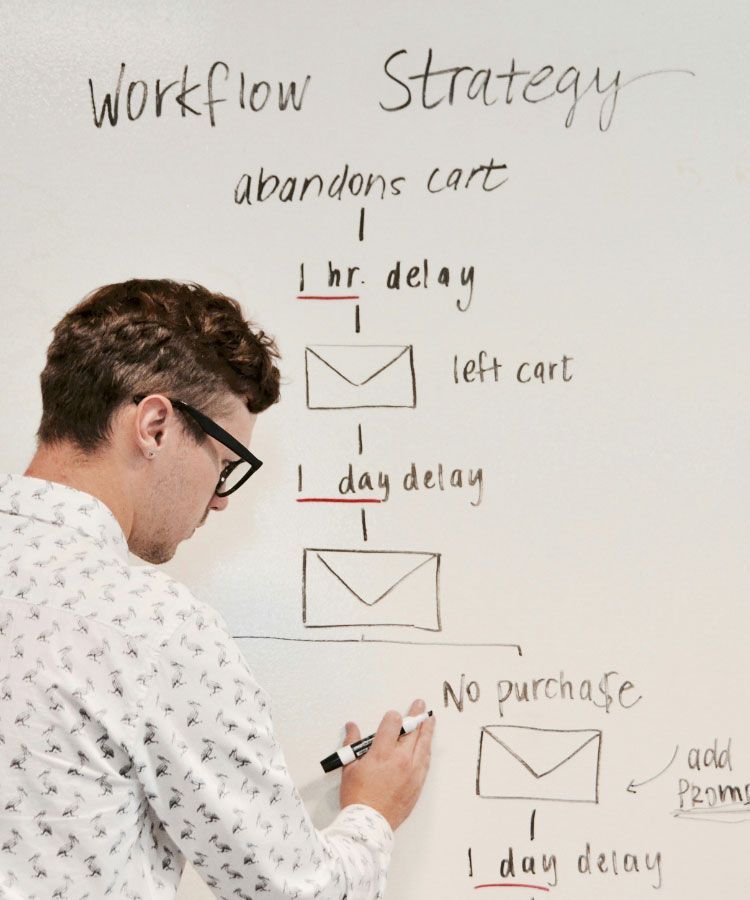
Growing your email database works best as a system, with maintenance, measurement, and consent built in from the start. That is how we treat email marketing inside a Marketing Operating System. List building connects to your signup forms, your CRM, and your marketing automation, so growth compounds instead of resetting every year. A system built on your own verified results takes you further – faster than one built on borrowed statistics.
A growing list is only half the equation. Once the right people are on it, the next step is your email marketing strategy: what you send them, from the first welcome email to the regular email newsletter. We cover that in our companion piece on how to craft effective email campaigns.
If you’d rather talk it through, book a Free Strategy Session with us. We’ll look at how your list is built and maintained today, and where you can grow your email list next.
Frequently Asked Questions
Do you have any questions on the above, or would you like to share your experience? Just email [email protected] or call 289-536-6797.
At Mawazo Marketing we work with owners of B2B companies who want to accelerate their business. We help them with a concrete digital growth plan, a website that saves operational cost, and a digital marketing system that generates leads. For qualifying clients we offer a 5x ROI guarantee: if we don't reach the objective, then we pay back the difference. Book a Free Strategy Session to find out more.