
How Online Price Estimators Help Business Owners Get Better Leads

When someone needs a new roof, an HVAC system, or a home renovation, they almost always start the same way: they search, skim a few websites, check reviews. and then try to figure out what the whole thing is going to cost.
Here's the problem. Most business websites don't answer that question. They say "Contact us for a quote" and ask visitors to fill out a form. For many buyers, that's where the journey ends. They don't want to talk to anyone yet. They want to understand the ballpark first, on their own terms.
This gap between what buyers want and what most websites offer is exactly where online price estimators come in.
What an Online Price Estimator Actually Does
An online price estimator is a tool on your website that helps visitors answer a simple question: "What would this cost for someone like me?"
It walks them through a few practical questions and returns a price range or starting estimate. Along the way, it explains what affects the cost: materials, complexity, optional add-ons etc. The buyer ends up with a clearer sense of budget and trade-offs, without feeling like they've been pulled into a sales conversation.
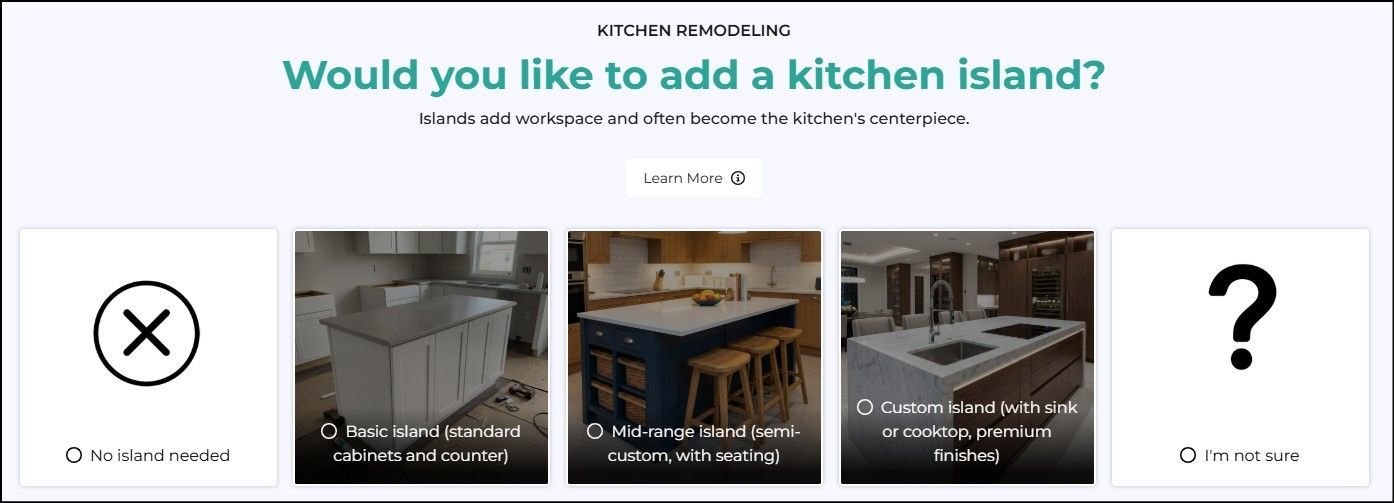
Along the way, you have opportunities to educate buyers without overwhelming them. Notice the "Learn More" option in the example above—it lets curious visitors dig deeper into why a kitchen island might affect their budget, while others can simply make their selection and move on. You can use these moments to explain trade-offs, highlight what's included at each level, or share examples of past work. The buyer stays in control of how much information they take in, but you're shaping how they think about the project before you ever speak to them.
When the estimate is ready, the online price estimator captures contact details and project information while filtering out visitors who were never serious buyers in the first place. It's essentially a pre-sales rep that works around the clock: educating prospects, setting expectations, and handing your team qualified leads when they're ready to talk.
A quick note on data: make sure you're clear about how you'll use the information people provide, and that your follow-up respects privacy rules. A simple line near the estimator explaining that details are used only to refine the estimate and respond to their enquiry goes a long way.
Where Price Estimators Fit in the Buyer Journey
To understand why estimators work, it helps to think about where buyers actually are when they land on your site.
Early stage: "What does this kind of thing usually cost?"
At this point, someone knows they have an issue—an aging roof, a security gap, a facility that needs attention—but they're still exploring. They're typing searches like "how much does roof replacement cost" or "HVAC installation price near me."
If your site offers a clear path to get a price range, that becomes the natural place to land. The estimator doesn't just spit out a number; it teaches them how pricing works in your industry and what decisions they'll need to make. You've moved them from vague curiosity to being genuinely informed about their options.
Middle stage: "Who should I work with?"
At this point, someone knows they have an issue—an aging roof, a security gap, a facility that needs attention—but they're still exploring. They're typing searches like "how much does roof replacement cost" or "HVAC installation price near me."
Late stage: "I'm ready to talk"
By the time someone submits their details through an estimator, you already have context: project type, scale, preferences, timeline. When your team follows up, they're not starting from scratch with "So, tell me about your project." They're confirming details, refining scope, and talking about value. That's a very different conversation.
Google's "Online Estimates" Feature: Why This Matters Right Now
Google has started rolling out a search feature in parts of the US called "Online estimates." When someone searches for services like roofing or other local trades, they can now filter results to show businesses that offer instant online pricing.
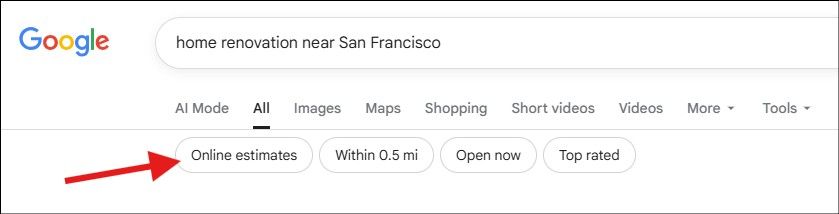
This isn't a small interface tweak. It's Google putting a spotlight on exactly what buyers have been asking for: clear, self-serve price guidance before they talk to anyone.
For years, the goal of most service business websites has been "get the form fill." Google is now nudging the market toward something different: answering the pricing question upfront. When Google introduces a filter called "Online estimates," they're signalling what they value. And most contractors have no idea this is happening.
That creates an opportunity. If you build a dedicated page with language that matches what Google is looking for, such as "online estimates" or "instant price range", then you're aligning with both how buyers search and how Google wants to organise results. Early movers here won't just look better to prospects; they'll likely show up more prominently in search.
The Impact: Better Leads, Not Just More Leads
The first thing many businesses notice after adding an estimator is that lead volume goes up. That's been a consistent pattern across different industries.
But the more important shift is in lead quality.
Someone who completes an estimator has already invested time. They've shared details about their situation and seen a realistic budget range. They're not just clicking a button; they're engaging with your process. That tends to filter out the "just browsing" visitors and surface people who are genuinely evaluating their options.
On your end, every submission comes with context. When your team reaches out, they already know what the prospect wants done, where, roughly when, and at what level of finish. That changes the nature of the conversation entirely. Shorter sales cycles. Fewer surprises when you quote. Higher close rates—without asking your team to work longer hours.
Addressing the Natural Concerns
If you're reading this and thinking "that sounds great in theory, but..."—you're not alone. A few concerns come up consistently.
"Our work is genuinely custom. A calculator can't capture that."
This is probably the most common hesitation, and it's understandable. No two projects are identical, especially in trades that involve complex variables like site conditions, materials, and client preferences.
But a good estimator doesn't pretend every job is the same. It asks the same initial questions your team already uses to shape a quote: approximate size, complexity, access, materials, add-ons. Then it gives a range—not a fixed number—and explains what moves that range up or down.
You're not replacing your quoting process. You're letting buyers see how it works before they ever talk to you. That actually helps them understand why detailed quotes require a site visit or consultation.
"Won't showing prices scare people away?"
What actually scares people is walking in blind. Buyers dislike uncertainty—the feeling that they could be massively overcharged and wouldn't even know it. When you offer a clear range with honest explanations of what affects cost, they feel more informed and more confident.
Yes, some visitors will see your range and realise they can't afford it. That's not a loss. Those people were never going to become customers, and now neither you nor they have wasted time on calls that go nowhere.
"I don't want competitors to see my prices."
In most markets, competitors already have a rough sense of what you charge, and you know roughly where they sit too. You don't win by hiding. You win by being the business that helps buyers understand value when they're trying to figure out who to trust.
Making This Work: Practical Steps
You don't need to rebuild your website to benefit from this shift. Here's a straightforward approach:
Create a dedicated page for estimates: Use language that matches what buyers (and Google) are looking for. Something like "Online Estimates" or "Get an Instant Price Range" as your page title. Include a line like: "Use our online estimator to get an instant price range in under two minutes."
Make the estimator prominent and simple:
Place it high on the page with a brief explanation: what questions you'll ask, what they'll get back (a range, not a binding quote), and what happens after they submit. Keep the experience fast—it should feel helpful, not like a chore.
Connect it to your broader marketing:
Add "Get an instant estimate" calls to action on your homepage, service pages, email signatures, and ads. You can include a QR code on print materials that takes people straight to the estimator. If you do site visits, ask prospects to complete the estimator beforehand so expectations are aligned and your team arrives prepared.
Start small if you're cautious: Roll it out for one service line or one region first. Measure what happens to lead volume and close rates. Expand once you can see the numbers for yourself.
What This Actually Changes
When you step back, an online price estimator isn't just another widget on your website. It changes how buyers experience your business.
Instead of forcing people to call for basic information, you give them a way to explore budget questions on their own terms. Instead of hiding pricing and hoping for form fills, you meet them where they already are: researching, comparing, and trying to avoid an expensive mistake.
The result is a pipeline filled with people who already understand your pricing and are serious about moving forward. Your team spends less time qualifying tyre-kickers and more time closing deals that were half-won before the first conversation.
If you're interested in seeing how this could work for your business, get in touch and we'll give you a demo and explore options for implementing a price guide on your website.
Do you have any questions on the above, or would you like to share your experience? Just email [email protected] or call +1 (833) 503-0807.
At Mawazo Marketing we work with owners of B2B companies who want to accelerate their business. We help them with a concrete digital growth plan, a website that saves operational cost, and a digital marketing system that generates leads. For qualifying clients we offer a 5x ROI guarantee: if we don't reach the objective, then we pay back the difference. Book a Free Strategy Session to find out more.