Digital Marketing Is a System

If you are a business leader in a field service company, you have probably felt the disconnect between marketing activity and real business results.
You have invested in a new website, maybe engaged an agency for SEO, and another agency is doing your social media. None of them are talking to each other, and none of them are accountable for revenue. The activity reports look busy, but there is no connection to business results. Now AI tools are flooding your feed, each one claiming to "10x" your marketing.
Instead of getting clarity on ROI, you are left with more questions: Is social media actually worth it for a B2B company like ours? Will people find us through ChatGPT instead of Google? And most importantly: which of these things actually leads to better customers and more profitable jobs?
From Random Acts of Marketing to a Digital Marketing System
Here is the hard truth: digital marketing should not be a collection of marketing tactics or AI shortcuts. It should be a system that works predictably.
For a field service executive responsible for technicians, trucks, branches, and service contracts, disconnected marketing is not just inefficient, it’s expensive and leads to lost opportunities.
Here is the difference at a glance:
Random Acts of Marketing
Website redesign every few years with no measurable change in sales
Website redesign every few years with no measurable change in sales
Separate vendors for SEO, ads, and social, no-one talking to each other
Activity reports full of clicks and impressions with no clear link to revenue
A Digital Marketing System
Website integrated with CRM and service tools, turning traffic into structured leads automatically
One strategy connecting all channels, with content, outreach, and ads working together
Analytics tied to real outcomes: leads, quotes, jobs, and dollars by channel
Sales and marketing aligned on the same data, working the same pipeline
This article will show you how to build a digital marketing system that actually works: a 360-degree approach where every element works together. It creates efficiency and reduces costs, and it generates leads and converts them into clients.
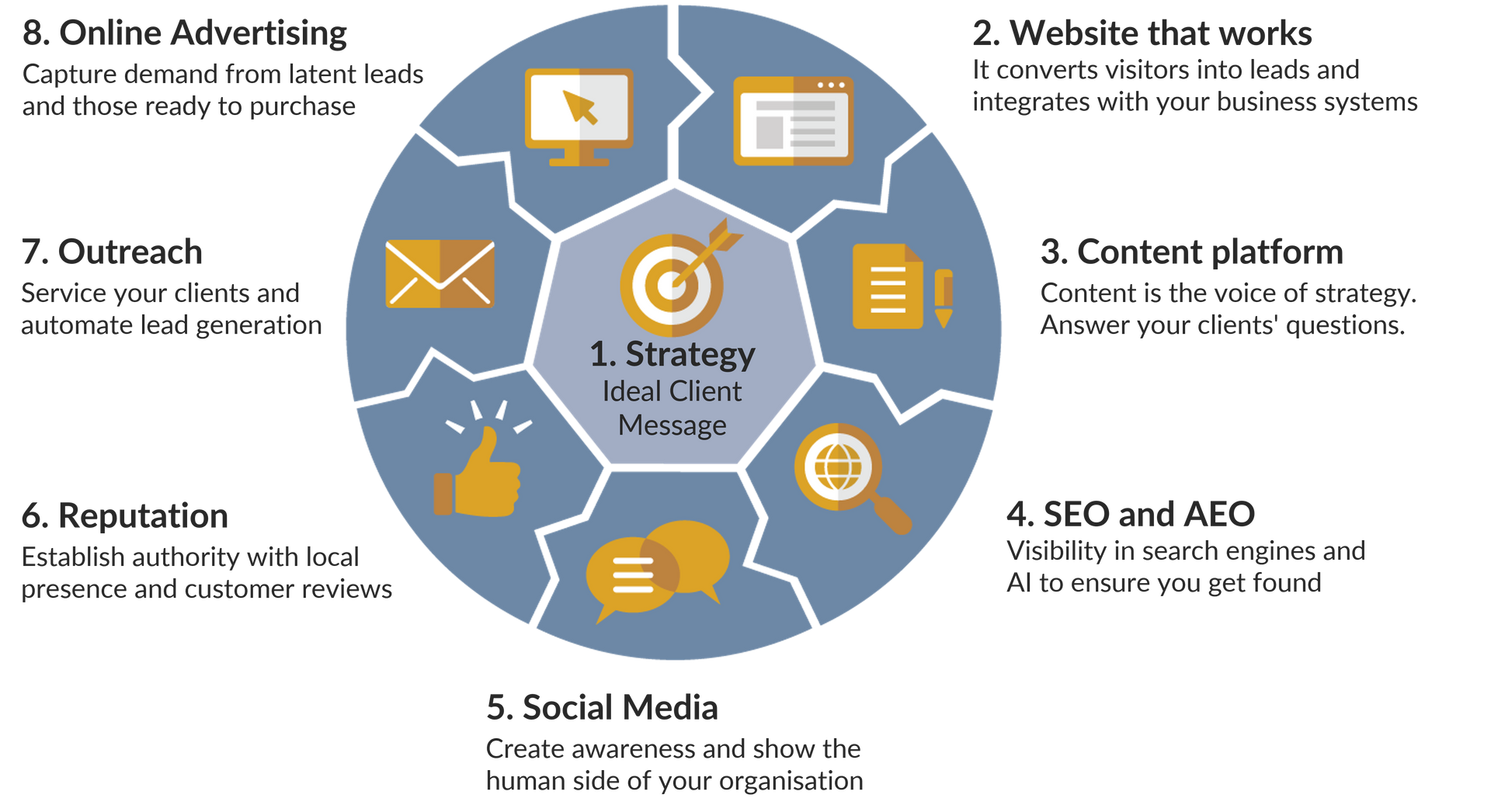
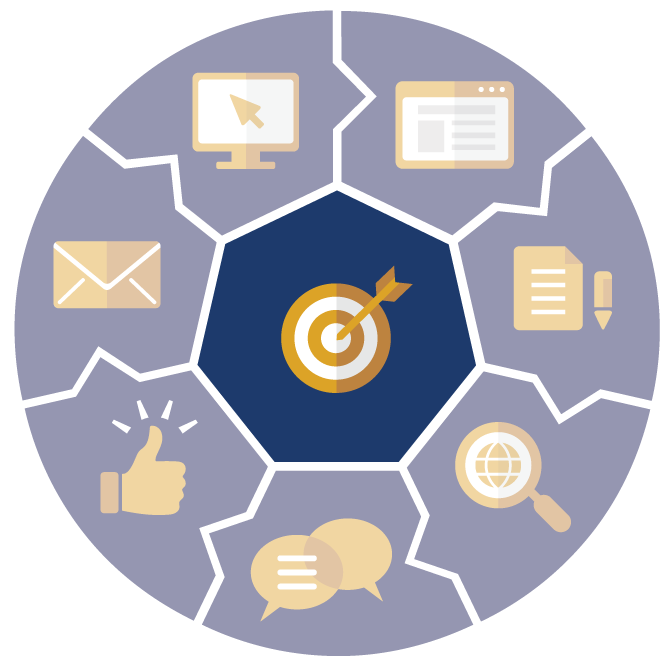
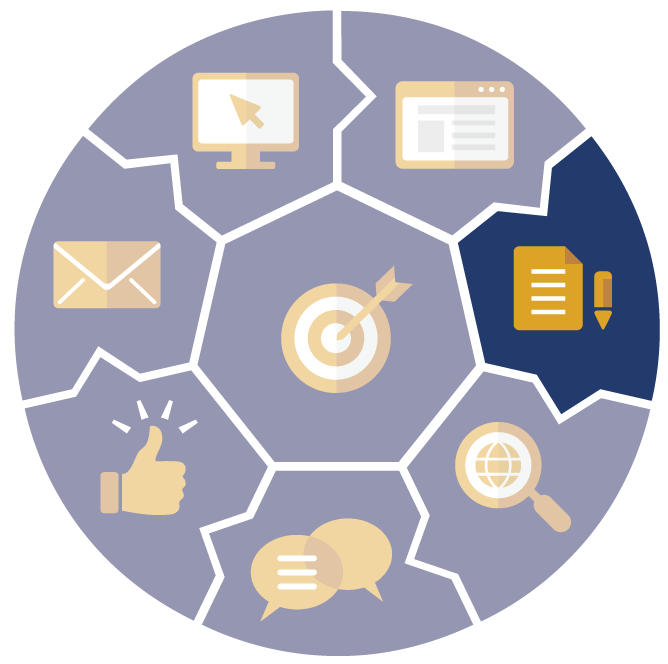
Strategy sits at the heart of the system. From there, all elements work together:
- Your website converts visitors into leads, integrated with your CRM and business systems.
- Content answers the questions your ideal clients are already asking.
- SEO and search optimization ensure your answers get found.
- Social media shows the human side of your business.
- Reputation builds trust through reviews and testimonials.
- Outreach nurtures leads through email, SMS, and sales automation.
- Advertising captures demand from people ready to engage.
- Analytics ties it all together, showing what is working and what to adjust.
By the end of this article, you will know exactly which components your digital marketing needs, how they connect, and where to start.
Start with Strategy
Every strong system starts with a blueprint. In digital marketing, that blueprint is your strategy.
Before you touch your website or ads, you need clarity on at least these three things: who your ideal clients are, what problems they are trying to solve, and how you solve those problems better than your competitors.
Understand your ideal client

Read more: How to define your Ideal Client
For a field service business, your ideal clients are rarely "everyone who needs what we do." More often, they fall into clear profiles: facility managers responsible for multiple sites, operations leaders under pressure to reduce downtime, or procurement teams tasked with consolidating vendors.
Each has different pressures. They worry about downtime and compliance. They need predictable response times. They want fewer vendors they can actually trust.
Your strategy needs to spell out how you solve these problems: faster response across locations, well-trained technicians who get it right the first time, and documentation that makes audits easier.
Differentiate your company from the competition
Then comes differentiation. Maybe it is your guaranteed response times. Maybe it is your local presence. Whatever it is, your strategy should capture it in simple language that you can use in both marketing and sales.

Create a core message
When you have defined your ideal client and your differentiator, then it's time to articulate this in your core message. Think of it as your elevator pitch: a clear, concise statement that targets the problems your ideal customers want to solve and clearly identifies how you are different from your competitors.
Read more: Create a Core Message that attracts Clients
A quick sanity check:
- Who are our ideal clients, and what problems matter most to them?
- How do we solve those problems better than our competitors?
- What is your core message that speaks to their problems and sets you apart?
If you cannot answer these clearly, no AI tool or ad platform will fix it.
A website that generates leads & reduces cost
Once your strategy is clear, the next piece is your website. For a field service business, this is not an online brochure. It is a business tool, open 24/7, doing real work for your team.

Engage leads and convert them into leads
Your website should do more than look professional, it should turn anonymous visitors into leads for your business. To achieve this:
- Focus on your client's problems: Your website should address the challenges your ideal clients face. It is not about your company; it is about them and how you solve their issues.
- Differentiate: Explain what makes your approach unique and why clients should trust you over competitors.
- Show the process: What are the main steps you guide clients through? Help them see the path from problem to solution.
- Call to action: Make the next step obvious. Whether it is requesting a quote, booking a service call, or downloading a guide, guide visitors toward engagement.
For multi-location companies, that also means clear navigation by service line and region, so prospects can quickly find what they need.
Save cost by integrating with your business system
The real power comes when your website integrates with the rest of your business:
- Forms that push leads directly into your CRM, instead of landing in a shared inbox.
- Service requests that trigger workflows for dispatch or scheduling.
- Lead capture that tags which campaign the inquiry came from.
This is where a digital marketing system starts to drive profit, not just revenue. If your website and systems save your team $100K in manual admin work over a year, that is $100K of profit. No materials, no technician hours. Compare that to $100K in new revenue, which might translate to a much smaller margin after labour and overhead.
Once forms and workflows are integrated, office staff stop re-keying information. Fewer errors slip through. Technicians show up with better information. Jobs close out faster. When you treat your website as a business tool, not a design project, you create a foundation that supports every other part of your system.
Case study: warehouse and inventory system
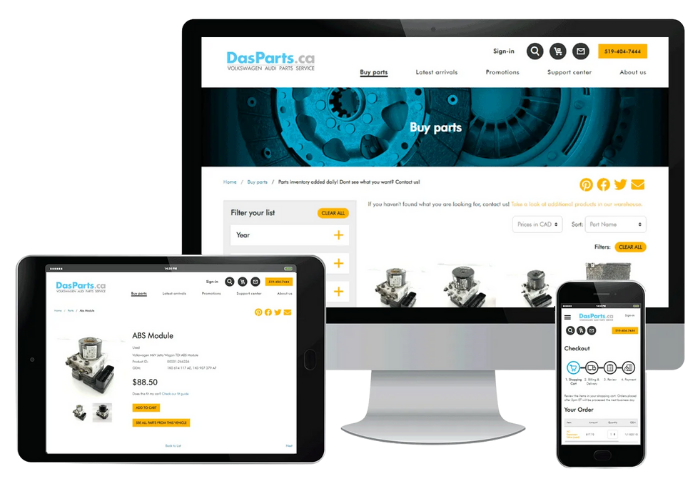
Dramatically improved efficiency of operations with a custom warehousing and inventory system, integrated with an eCommerce website and Quickbooks Online.
Read more: Integrated Warehouse Management, eCommerce & Bookkeeping
Content That Answers Your Clients' Questions
With your strategy and website in place, the next part is content. Not content for its own sake, but content that answers the questions your ideal clients already have.
If you listen to your technicians and sales team, you will notice the same questions
repeating: How often should we service this equipment? What does a good maintenance contract include? What is the risk if we delay this repair? Those questions are the roadmap for your content marketing.
For a field service company, great content does not have to be flashy. It needs to be useful and grounded in your real work: maintenance guides for key equipment, checklists facility managers can use with their own teams, case studies that show how you solved real problems, and explainers on compliance and inspection requirements.
From Random Content to a Content System
The difference between random content and a content system is simple. Random means someone writes a blog post when they have time, about whatever seems interesting that day. A content system is intentional:
- Every piece is tied to a specific ideal client, problem, and stage in the buying journey.
- Content is repurposed across channels—social media, email newsletters, Google Business Profile, advertising, and press releases.
- Over time, related pieces form hub pages: central resources on key topics that anchor your SEO and double as sales tools.
Building this system starts with mapping the issues and questions relevant to your clients, organizing them into topics, and creating a content calendar to execute consistently.
AI tools can help you repurpose content faster. But they cannot decide which questions matter most. That direction has to come from your strategy and your clients.
Case study: Lift & Shift hub page
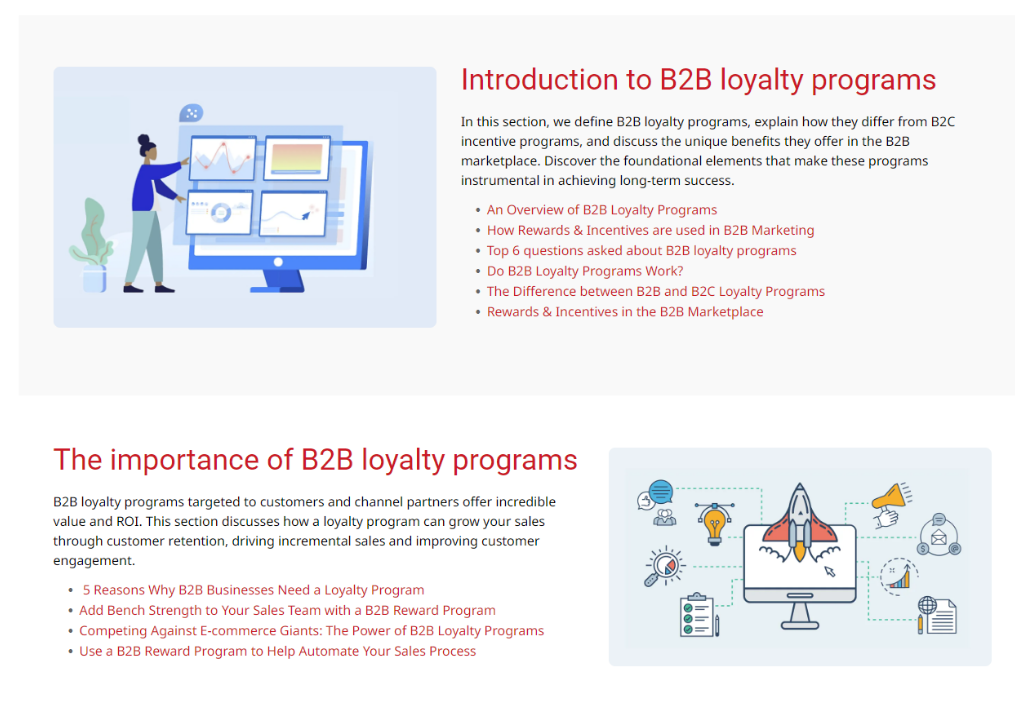
For our client Lift & Shift we created a comprehensive hub page titled "The Ultimate Guide to B2B Loyalty Programs"
This page links to all relevant blog posts, forming a rich resource hub. Such an approach enhances user experience and confirms your authority on the topic to search engines like Google.
Getting Found: SEO and Local Search
Once you are creating useful content, the next question is: how do people find it?
That is where SEO comes in. Search Engine Optimization helps your pages show up when potential clients search Google. For a field service company, those searches often sound like: "automatic door repair near me," "commercial HVAC emergency service," or "security system maintenance checklist."
As AI tools become part of how people search, these fundamentals do not change. The companies that rank well or get recommended by AI are the ones that consistently publish clear, useful answers.

SEO is not a one-time setup; it is an ongoing effort. At its core, it comes down to three things:
- Website structure: Is your site secure, mobile-friendly, and fast to load?
- Content: Does each service have its own page? Is there enough useful content to answer your clients' questions?
- Backlinks: Are other reputable websites linking to yours? These act as votes of confidence that signal your content is valuable.
Your system ties this together: strategy tells you which questions to target, content provides the answers, and SEO makes sure those answers get found.
Local SEO: a game-changer for field service companies
For businesses with physical locations serving local customers, local SEO is critical. Many of our clients generate 25% or more of their leads from Google Business Profile alone.
Local SEO focuses on three areas:
- Google Business Profile: Your GBP lets you list services, post updates, collect reviews, and appear in map searches. For multi-location companies, each location needs its own complete and accurate profile.
- Business directories: Your details should be consistently listed across directories like Yelp, YellowPages, and the Better Business Bureau. Inconsistent information hurts your rankings.
- Location pages on your website: Each location should have its own page with address, contact information, services offered, and service area.
When someone searches "near me," Google weighs your GBP completeness, your reviews, and your local relevance. Getting this right means showing up when it matters most—right when a prospect is ready to act.
Case study:
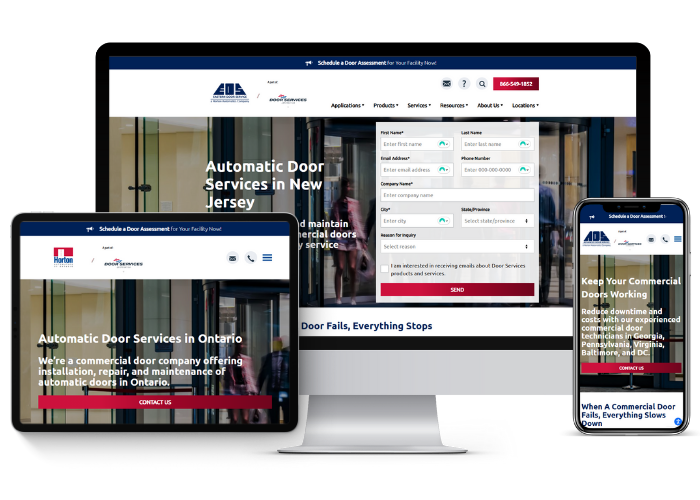
SEO Horton Automatics
Since 2017, we have optimized the web presence of Horton Automatics of Ontario for search engine ranking. In 2022, our Digital Marketing System delivered 20% annual growth and $1.5M in sales, with 15x Return on Investment. Based on this success, the ten sister companies of Door Services Corporation have now merged into a new web presence that competes well with its nationwide competitors.
Read more: Optimizing a Website for GoogleSearch Results
Social Media – Building Trust Before the First Call
Many field service leaders are skeptical about social media. "Our buyers are serious people. Do they really care what we post on LinkedIn?". The answer is yes—but not in the way most agencies would have you believe.
Your buyers are people making decisions that affect their operations, their teams, and their reputations. Before they take a meeting or respond to an RFP, they want to know: Who will show up at my site? Do they take safety seriously? What kind of company am I dealing with?
Social media, used correctly, answers these questions long before a formal conversation begins.

Social Media as part of your digital marketing system
In isolation, social media is just another platform demanding content and becoming a distraction. But as part of your integrated digital marketing system, it serves three clear purposes:
- Amplifying content you're already creating: every article, case study, and guide you publish can be repurposed into multiple social posts spread throughout the year.
- Showcasing reviews and proof: your Google reviews, client wins, and project completions become social proof that builds trust with prospects who aren't ready to buy yet.
- Revealing the human side of your business: the people, safety culture, and real work behind your brand differentiate you from competitors who stay anonymous.
What actually works in social media for field service companies
Your audience doesn't want corporate fluff. They respond to real moments: a technician who solved a tricky problem, before and after photos showing quality work, safety milestones and training that proves you take their concerns seriously, and behind-the-scenes glimpses of the people they'll actually work with.
These posts build familiarity. When someone has followed your updates for months, you're no longer just another name on a vendor list. You're a known, proven option.
The bottom line
Social media works when it serves your business goals, not when you serve the platform. As part of your 360° marketing system, it amplifies your content and builds trust with future clients, without requiring you to become a full-time content creator.
Reputation: Digital Word-of-Mouth That Works Around the Clock
In field service, word-of-mouth has always mattered. Today, a big part of that trust lives in online reviews and testimonials.
Before they invite your technicians onto their site, prospects will search your company name plus "reviews," check your Google Business Profile, and scan your website for proof. They're asking: "Can I trust this company to show up and handle problems correctly?"

The answer to that question is now visible to everyone: when you search for field service companies in your area, notice which ones appear first and which ones get ignored. A company with 50+ Google reviews and a 4.8-star rating stands out. A company with three reviews looks inactive. Prospects make immediate judgments based on what they see.
Your reputation is being built whether you manage it or not. The question is whether you're steering the conversation or letting it happen to you.
Reviews as part of your system
A digital marketing system treats reputation as a deliberate process, not a happy accident.
Your system should generate a steady flow of authentic reviews by sending review requests automatically after job completion while the experience is fresh. We typically see 2-5% of customers leave a review when asked properly. That might sound low, but it compounds. Five reviews per month becomes 60 per year, which puts you ahead of most competitors within 18 months.
Read more: How to easily get more positive Google Reviews
Replying to reviews should be part of your system as well. Reply to every review within 48 hours, especially negative ones. Thank people for their time. Address concerns professionally and publicly.
Then put those reviews to work. Feature the best ones prominently on your website. Include relevant testimonials in proposals and email signatures. Share them on social media. Use them in sales conversations when handling objections.
Over time, your reviews become a living proof library that works for you even when your team is offline.
Outreach: Turning Interest Into Revenue
So far, we have focused on how people find you and why they trust you. Outreach is about what happens next: how you stay in touch and turn interest into profitable work.
For field service companies, outreach works on two fronts: automated systems that nurture prospects, and proactive sales conversations that uncover opportunities your competitors never see.

Automated nurture
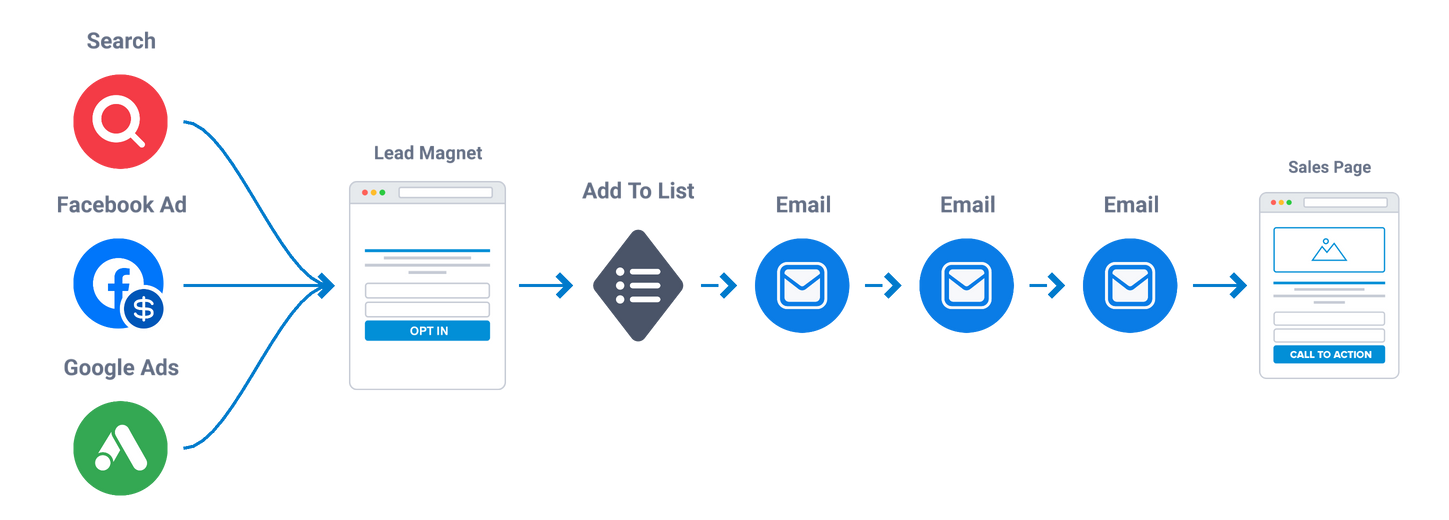
Picture this: a facility manager downloads a maintenance checklist from your website. Over the next few weeks, they receive emails with practical tips, a relevant case study, and a clear invitation to discuss a service plan. When they're ready to move, they already know who you are and what to expect.
That's a simple sales funnel. A valuable download captures contact information. An automated email sequence delivers relevant content over 3-6 weeks. Each message provides value and includes a clear next step. When someone engages, your sales team receives a notification with full context.
Proactive sales outreach
But here's what separates growing companies from stagnant ones: your sales team also picks up the phone. Not to take orders or handle problems, but to build relationships. Calling existing clients to introduce a service they didn't know you offered. Checking in after a project to discuss preventive maintenance. Reaching out to prospects who visited your website but haven't taken the next step.
Most field service companies wait for the phone to ring. Your competitors hope for RFPs to land in their inbox. Meanwhile, your team is having conversations and uncovering projects that never make it to a formal bid process.
When we coach clients on systematic sales outreach—combining smart targeting, valuable conversations, and consistent follow-
through—we typically see 15-30% annual revenue growth.
Bridging marketing and sales
The real power comes when these work together. Marketing provides context: which pages prospects visited, which content they downloaded, which services they researched. That turns a cold call into a warm conversation. Sales has ammunition: case studies, guides, and checklists that answer objections and demonstrate expertise.
When automated outreach, proactive sales calls, and coaching work together, your team isn't waiting for problems. They're leading conversations and uncovering opportunities that would never show up as an RFP.
Advertising: Capturing Demand Now and Creating It for Later
When most leaders think about digital advertising, they think about people already searching: "automatic door repair near me" or "elevator service Toronto." That's where Google Search Ads shine—capturing someone the moment they're looking for help.
But not everyone searches at the moment they start thinking about a problem. There's a whole group of ideal clients who match your profile and feel the pain of downtime or inconsistent vendors, but aren't yet typing those problems into Google.
That's where LinkedIn and Facebook ads come in.
In a digital marketing system, advertising plays two distinct roles:

Capture existing demand (Google and Bing Ads)
When someone searches for your service, your ad appears at the top of results. These are high-intent leads—people ready to buy, compare quotes, or schedule service. Google advertising works because it catches people at the decision point. The challenge is competition and cost. Popular search terms can be expensive, and you're fighting for attention with every other company in your market.
Shape future demand (LinkedIn and Facebook Ads)
On LinkedIn, you can target facility managers, operations directors, and procurement leads before they have an urgent problem. On Facebook, you can build awareness in specific geographies and demographics. These platforms let you stay visible to ideal clients during the months before they search, so when they do need help, you're already a familiar name.
Making it work
To keep advertising practical and profitable:
- Focus on a small number of services where you deliver exceptional value
- Send traffic to landing pages that connect into your CRM and track conversions
- Use call tracking so you see which campaigns turn into real jobs, not just clicks
Make sure your ads are connected to your CRM, measured against actual revenue, and supported by strong content. That’s when you're not just buying clicks but working your complete digital marketing system. You're putting the right message in front of the right people at the right time, whether they're searching today or will search six months from now.
Analytics – The Control System for Your Marketing Engine
By now, you have seen the main components: strategy, website, content, search, social, reputation, outreach, and ads. Analytics is not one more component on that list—it's the control system for the entire engine.
Without it, you're flying blind. You can't see whether your marketing investment is actually working. One of the main advantages of digital marketing is the ability to measure results in real time and adjust strategies accordingly.
Start with clear goals
Before diving into dashboards, decide what you're trying to achieve. What are your business goals? How many qualified leads do you need each month? What's an acceptable cost per lead? When these goals are defined, you can select the right metrics to measure progress and make informed decisions.
What strong analytics looks like
A complete analytics system gives you visibility into:
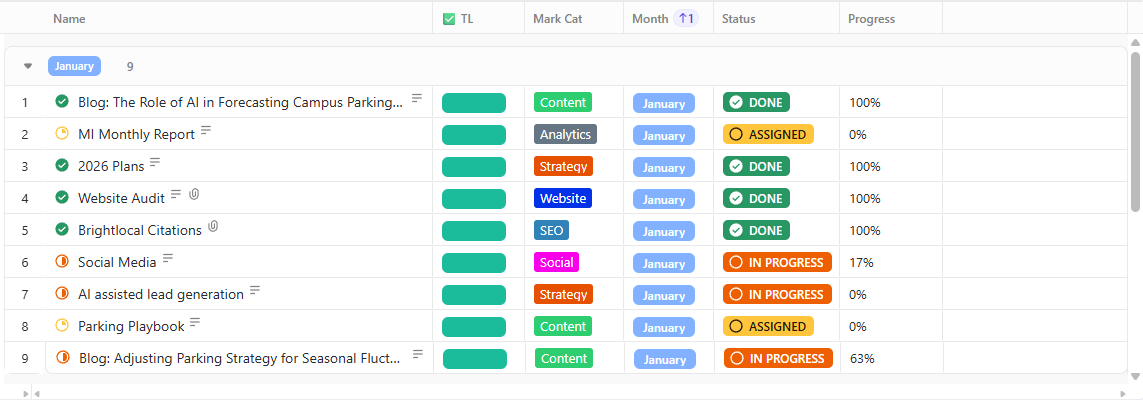
What's happening right now: Content being published, campaigns running, technical improvements being made, outreach activities in progress. You see exactly what work is being done for you without chasing status updates.
What those activities produce: Phone calls tied to specific campaigns, form submissions from qualified prospects, search rankings for key terms, website traffic and conversions, lead value by source and channel. You see the business results of each initiative.
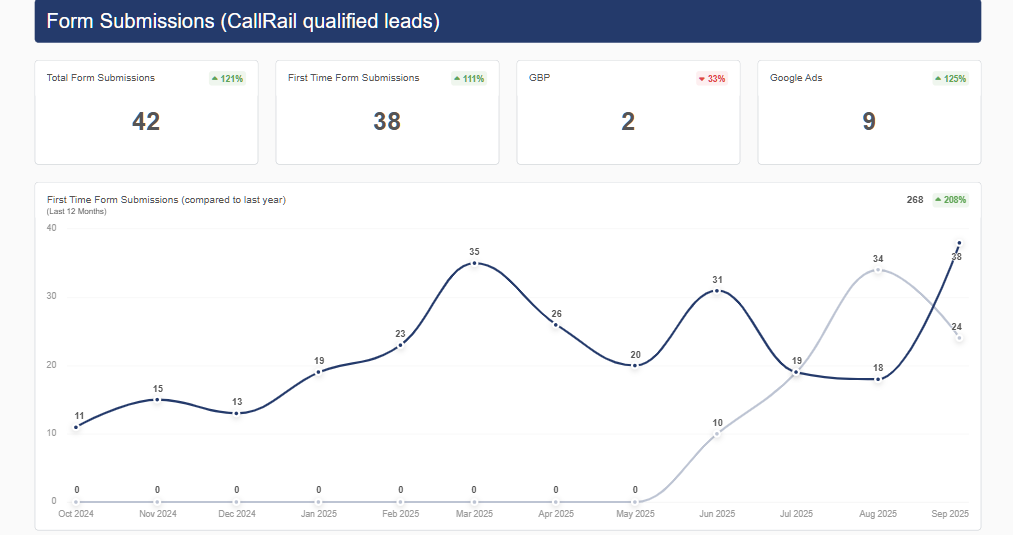
This dual view means you're never left wondering "What are they actually doing?" while also seeing clear evidence of what's working.
Bringing it all together
Your analytics come from multiple sources such as website tracking, advertising platforms, social media, and CRM data, but they should all be visible in one dashboard. This gives you a complete picture without logging into different systems.
Call tracking is particularly important for field service companies. By assigning different phone numbers to each marketing effort (e.g. your Google Business Profile, your website, your vehicles), you see exactly which campaigns generate calls and can trace inquiries back to specific tactics.
Connecting marketing revenue
The most powerful analytics tie leads directly to revenue. Together, we define a Lead Value model based on your average deal size, gross margin, and conversion rates.
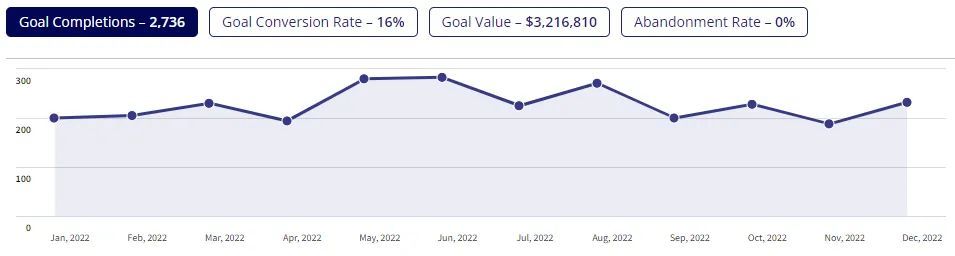
For example, implementing this approach for Horton Automatics lets us know precisely how much revenue their digital marketing system generates. In 2022, we delivered 20% annual growth and $1.5M in sales in 2022, with 15x Return on Investment.
Read more: Case Study Horton Automatics
When analytics functions as your control system, your marketing stops being a guessing game. It becomes continuous improvement—where every month the engine gets more efficient and more profitable.
What a Digital Marketing System Delivers
When you start with strategy and build a digital marketing system where all components work together, then the impact compounds over time. Here's what a true digital marketing system delivers for field service companies:
- Measurable ROI and cost savings. A long-term client in a complex service industry achieved roughly 15x ROI on their digital investment. Beyond lead generation, they integrated their website, CRM, and internal tools, eliminating over $100K in manual admin work—pure profit, year after year.
- Predictable growth engines. Another client transformed their digital marketing from occasional experiments into a reliable growth driver. With clear strategy, an integrated website, consistent content, and targeted outreach, they expanded services and locations with confidence, finally understanding which levers drove profitable demand.
- Accelerated revenue growth. Clients who combine the full system with Sales Coaching often see 15–30% annual revenue growth. Not by burning out teams, but by attracting the right opportunities, equipping sales for better conversations, and using data to focus on high-value accounts.
None of these results came from a single campaign, platform, or clever ad. They came from systems that work, because businesses committed to working the system.
The Cost of Staying Tactical
Most field service businesses stay in tactical mode: approving a website redesign, testing some ads, posting on social media when someone has time. On the surface, it feels like progress. Underneath, the costs stack up:
- Sales and marketing stay misaligned. Sales complains about lead quality. Marketing blames sales for not converting leads. Executives lack clear numbers to resolve it.
- Manual work never ends. Admin teams re-enter data from website forms, emails, and PDFs into spreadsheets, CRMs, and dispatch tools. Errors creep in and jobs get delayed.
- You don’t know what works. Reports show clicks and impressions, but not which campaigns turn into the right contracts, at the right margins, in the right regions.
- Your team is firefighting instead of improving. Every quarter brings another random marketing act instead of a deliberate, compounding plan.
Individually, these issues are manageable. Together they add up to lost market share, lower profitability, and a business that feels harder to run than it should.
The real cost isn't wasted marketing spend, it's the opportunity cost of not having an engine you can trust to steadily bring in the right work, at the right price, with far less effort.
Where to Start
If your marketing feels more tactical than systematic, then don't try to fix everything at once. Start by mapping what you already have against the components of the digital marketing system:
- Strategy
- Website and integrations
- Content
- SEO and local search
- Social media
- Reputation
- Outreach
- Advertising
- Analytics
From there, focus on three steps:
- First, strengthen the blueprint. Clarify your ideal clients, their problems, and how you solve them better. Ensure your core message appears consistently in your website, proposals, and sales conversations.
- Second, fix the foundation. Treat your website as a digital branch office, not a brochure. Connect forms and key actions to your CRM and service tools. Implement basic analytics and call tracking to see what's working.
- Third, layer in growth drivers. Build content around real client questions. Systematize reviews and social proof. Add outreach, Sales Coaching, and targeted ads once the basics are solid.
Ready to move faster?
You can build this system yourself, or you can work with experts who've done it dozens of times. If you'd like a structured walkthrough of your current marketing, sales, and operations—and a clear view of how a system could work for your business—start with a focused Digital Marketing System Assessment for your field service company.
Do you have any questions on the above, or would you like to share your experience? Just email [email protected] or call (833) 503-0807.
At Mawazo Marketing we work with owners of B2B companies who want to accelerate their business. We help them with a concrete digital growth plan, a website that saves operational cost, and a digital marketing system that generates leads. For qualifying clients we offer a 5x ROI guarantee: if we don't reach the objective, then we pay back the difference. Book a Free Strategy Session to find out more.