B2B Website Development Services that Integrate with your Business Systems
A web development company that focuses on cost of operations and lead generation
Most B2B service companies want to grow their profits, and increasing revenue can seem like the obvious answer. The problem is that more revenue often means more work for a team that’s already stretched. Experienced staff are hard to find, day-to-day operations take time to manage, and adding more customers can put even more pressure on processes that are struggling to keep up.
But increasing revenue isn’t the only way to improve your bottom line. As your business grows, inefficient processes, duplicate work and manual tasks can quietly eat into your margins. Finding and fixing those inefficiencies can create opportunities to increase profit with the people and revenue you already have. Often, that starts by connecting your website with the business systems you rely on for production, ordering, fulfilment and accounting.
Architects in website design and development
Our web development services start with finding hidden profits in your business systems. Basically we find opportunities to make your operations more efficient by introducing automations and integrating your online presence with your business systems.
We first build a prototype so you know exactly how we will reduce your overhead before you make any substantial investments. Then we create your automation engine to simplify your operations and eliminate costly mistakes.
Many of our clients save $100K per year or more from operational efficiencies created in this phase, and that cost saving goes straight to your bottom line. You will need this efficiency accelerator so you can handle the sales volume that will come from our
digital marketing system!
A clear process for web development services
We use a proven 7-step process to plan, design and develop your website. It helps us understand your business objectives and the needs of your audience while considering both the front-end experience and the back-end functionality required to support your business.
You review and approve the work at key stages throughout the process. This gives you a clear picture of how your website will work and look before we move into the next stage, reducing costly changes and making sure there are no surprises at the end of the project.
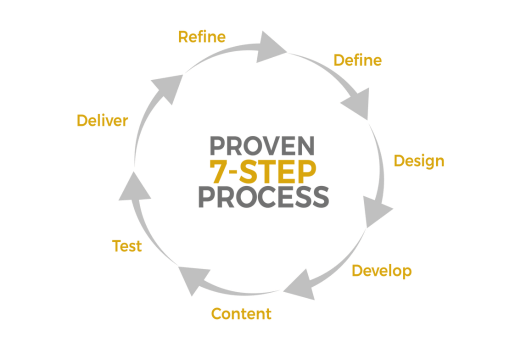
Step 1: Define
We start by defining what your website needs to accomplish for your business and, just as importantly, for your customers. We work with your team to map the key user journeys, which is ultimately how users complete actions on the website. At this point, your website is more appropriately called a web application. As part of this process, we look at your business procedures and how the web application needs to work with your existing business systems.
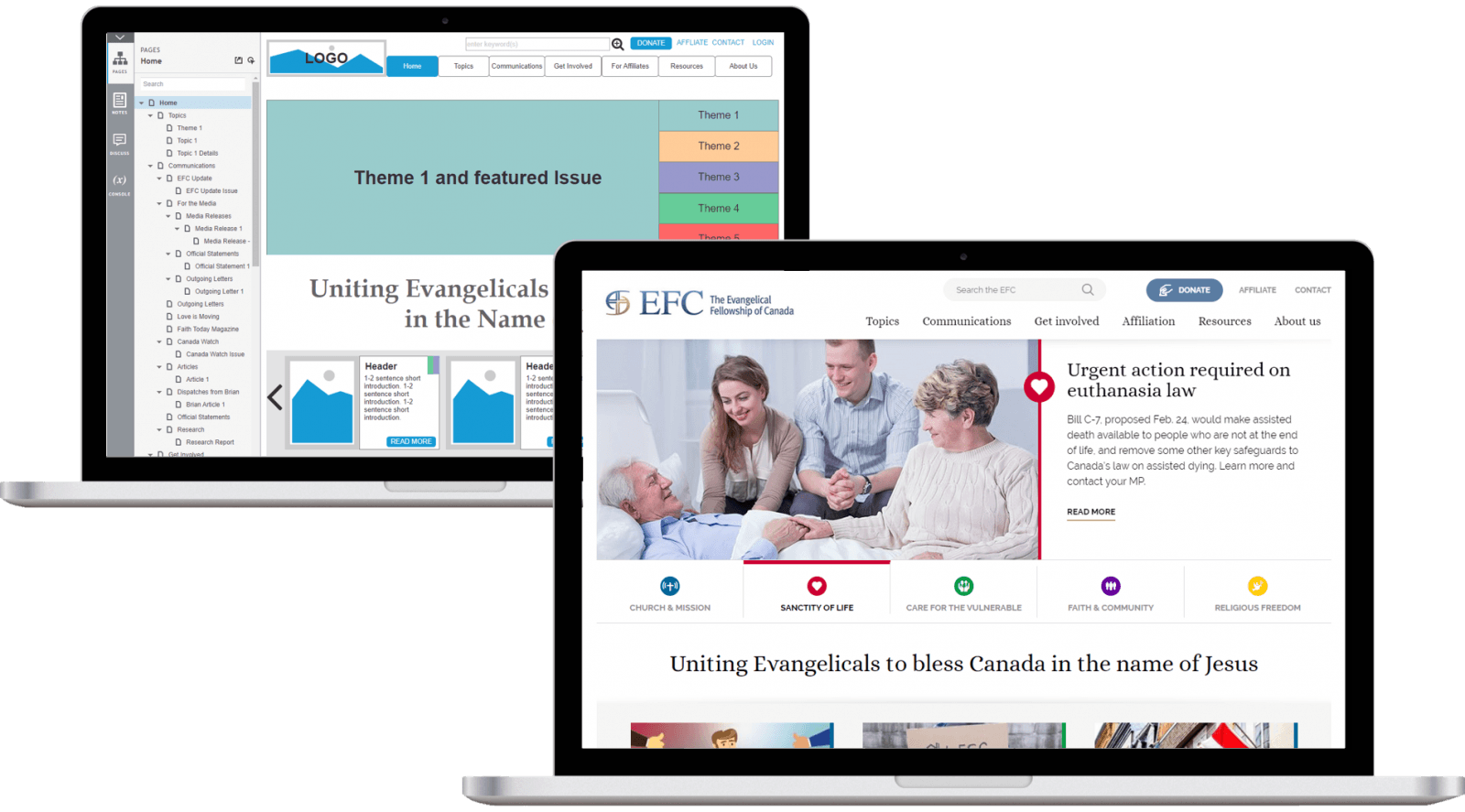
For these larger or more complex projects, we create wireframes to outline the website structure and key functionality. Wireframes are an interactive prototype that show how information will be organized and help us define how customers and administrators will move through the website.
The Define Phase gives us a practical roadmap for the rest of the project. It allows important questions to be answered early, when changes are easier and less expensive to make. With the requirements and prototype confirmed, we can establish the scope, budget and implementation plan with greater confidence. This upfront work helps development run more efficiently and reduces the risk of costly changes later.
Below is an example of the wireframes created for the website of the Evangelical Fellowship of Canada, as well as the resulting web page created from the wireframes.
We also establish clear design guidelines before the creative work begins. These cover your branding, the user experience and the functionality your website needs to support. Every website we build is responsive, so the experience works seamlessly across desktop, laptop, tablet and mobile devices.
Step 2: Design
In this stage we develop the visual design of the web application based on the user experience and structure defined earlier.
This includes creating the graphic design for the homepage and key page templates, establishing typography, colour palettes, imagery, and visual elements that reflect your brand.
The design process focuses on what works best for your target audiences, ensuring that the visual presentation supports how different users interact with the website or web application. A careful balance is established between branding, usability, accessibility, functionality, responsiveness, and compatibility with the underlying technology stack. The goal is to create a visually cohesive interface that represents your organization effectively while delivering a clear and consistent experience across devices.
Step 3: Develop
With the prototype and design approved, our development team brings your website to life. A dedicated project manager oversees the process, making sure the website is built according to the agreed functionality and design requirements, while following industry best practices.
Your website is built on a Content Management System (CMS), giving your team the ability to create and update content without needing technical expertise. We’re platform-agnostic, which means we don’t start with a preferred technology and try to make your requirements fit. Instead, we recommend the platform that makes the most sense for your website, your business needs and your budget.
If you sell products or services online, we can also incorporate eCommerce functionality. This can include everything from helping customers sort and filter products to integrating the website with the systems needed to manage online orders. See our eCommerce page for more information.
Duda allows for fast and cost-effective deployment of page-based websites hosted on a secure platform
Umbraco offers a powerful, intuitive platform that empowers businesses to manage their websites with ease.
Step 4: Content
While development is underway, we work with you to determine where your website content will come from and how it will be managed. This can be done in various ways.
We can bring across relevant content from your existing website, identify gaps and establish a practical process for your team to provide or update what’s needed. Other content can be managed directly through the website’s Content Management System (CMS), giving your team control over day-to-day updates.
If your project includes integrations, it is likely some content or data is coming directly from your internal business systems, such as an ERP or CRM. Depending on your requirements, this information can be synchronized automatically, updated on a schedule or retrieved when it’s needed.
Often, the best approach is a combination: your business systems manage the data they’re designed to handle, while the CMS manages your marketing and informational content. The goal is to make content accurate and easy to maintain without creating unnecessary work for your team.
Step 5: Test
Before launch, we thoroughly test your website to make sure it works as intended and meets the requirements established earlier in the project.
We test against the agreed specifications, from the visual design and user experience to content management and eCommerce functionality, if relevant. Where your website is integrated with other business systems, we also test the flow and synchronization of data to make sure information moves between systems as expected.
We test across browsers, devices and screen sizes to provide a consistent experience whether your customers are using a desktop, tablet or mobile device.
Once our internal testing is complete, your team conducts User Acceptance Testing (UAT). This gives you the opportunity to test the website against your day-to-day business processes and confirm that everything is working as agreed before launch.
Step 6: Deliver
Once testing and User Acceptance Testing are complete, we prepare your website for launch. Your project manager coordinates the final steps with your team, making sure everything is ready and that everyone knows what to expect.
Before going live, we complete a final review and confirm that the website meets the agreed requirements. We also coordinate the timing of the launch to minimize disruption to your business and make the transition as smooth as possible.
We provide training so your team is comfortable managing and updating the website. Once everything has been reviewed and approved, your new website is ready to go live.
Step 7: Refine
Launching your website isn’t the end of the process. Once people start using it, we can see what’s working, where they may be running into difficulties and where there are opportunities to improve the experience.
We review website performance and user behaviour against the goals established for the project. We also monitor changes in how search engines and AI engines discover, understand and surface content, so we can identify when your website needs to adapt for visibility. This helps us make informed improvements rather than making changes based on assumptions.
We can continue to support your team after launch through monthly support and maintenance plans. As your business, your customers and the digital landscape change, your website can evolve with them, helping it remain useful, visible and effective over time.
What next? Implementing our digital marketing system
When your website is completed and launched, then you are ready to implement the next phase: a digital marketing system
Web development
Just having a website isn’t enough to attract and engage prospects and convert them to clients. Our digital marketing system is a comprehensive approach to marketing where marketing tactics work together and deliver leads in a measurable way. For qualifying clients we offer a 5x ROI guarantee on your digital marketing investment!
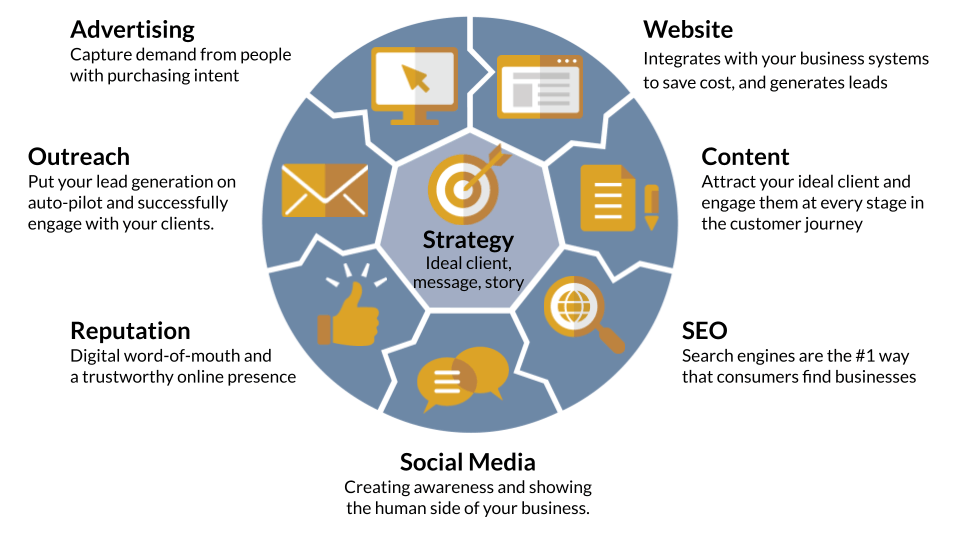
We implement your digital marketing strategy by:
- continuously updating and optimizing your website,
- answering the needs of your audience with content marketing,
- using search engine optimization to optimize your website for search engine ranking,
- engaging your audience with social media marketing,
- getting reviews and testimonials from your clients, and backlinks from other websites,
- reaching out to leads and clients with email marketing, SMS outreach and sales automation,
- and using online advertising to capture direct and latent demand.
Finally, we measure success with analytics and reporting on Key Performance Indicators (KPIs).
Read more about our Digital Marketing Services.
Would you like to know more?
Web Design and Development - Contact Us
What our clients say about our website development services














Partnerships and certifications









Book your FREE strategy session!
Frequently Asked Questions about our web development services
Web design and web development insights from our blog