Four Local SEO Levers Every Field Service Company Needs to Pull

For multi-location field service companies, local rankings are earned location by location
Here is the system that makes every branch competitive
Imagine your Burlington location gets calls every morning and your technicians are booked a week out. Meanwhile, your Hamilton branch does the same quality work, and barely gets enough calls to fill the day.
Google does not evaluate your brand as a whole. It evaluates each location as its own local business, weighing three factors: relevance, proximity, and prominence. A location that is weak on any of these will lose to a competitor that treats local SEO as a system.
Local SEO has two sides. One side lives on your website — the pages, keywords, and technical signals you build on the one platform you fully own. The other side lives off your website, on platforms and directories you do not control. This article covers the off-site side: four levers that determine how each of your locations shows up across Google, directories, and the wider web.
Pull all four consistently, and you start building a system that strengthens the online presence of every location you operate.
Lever 1 — Google Business Profile: your digital front door
For most customers, your Google Business Profile is the first and only thing they see before deciding to call. Businesses that show next to the Google Map see average increases of 300 to 500 percent in direction requests, phone calls, and website visits compared to those outside it.
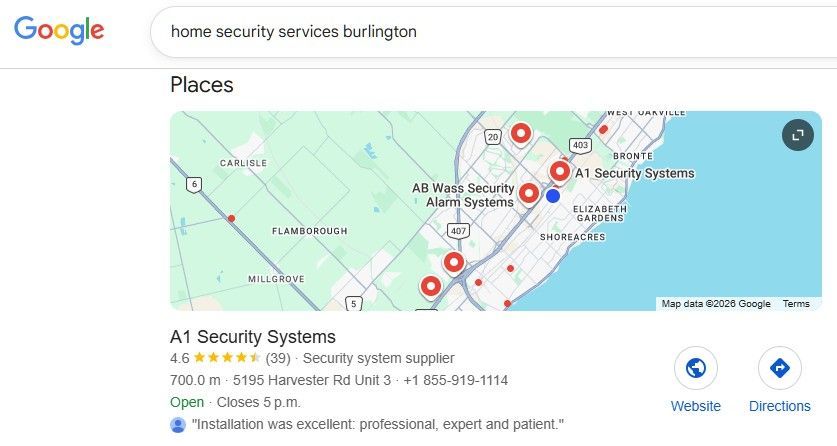
Our client A1 Security Systems shows up as the first entry in the local map pack on the Google search results page for “home security services burlington”
Every location needs its own fully built-out GBP with:
- the exact business name,
- the right primary category for the trade,
- secondary categories for sub-services, and a completely filled-out Services section.
- accurate hours,
- a matching phone number, and
- the correct website URL
Google treats GBP activity as a popularity signal. Posting weekly keeps a profile classified as active. Real job-site photos, technician and truck images, and short videos of completed work all strengthen a profile.
Lever 2 — NAP Citations: proving every location is real
NAP stands for Name, Address, and Phone Number. Google's search engine cross-references this information across the web on local directories such as Yelp, YellowPages, BBB and the Chamber of Commerce, to verify that each location is real and reliably located. Even minor inconsistencies erode trust and suppress rankings, so make sure the address is always formatted the same, and you use the same phone number everywhere.
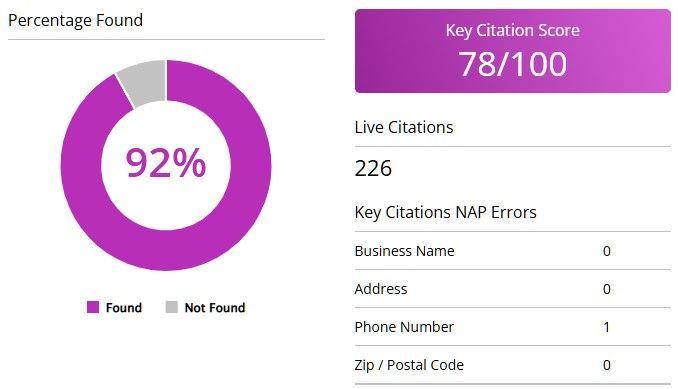
226 Live Citations for A1 Security Systems, 92% of available citations
For multi-location operators, NAP inconsistency is often the biggest hidden drag on local performance. Most companies do not find it until they run a proper audit. Old addresses, different phone number formats, and duplicate listings quietly push your locations further from the nearby customers who are actively searching for your services. Keeping your local listings clean and consistent across every directory is one of the highest-leverage actions you can take before anything else.
Lever 3 — Customer Reviews: the fuel for rankings and revenue
Reviews are one of the top local ranking factors in 2026. Google weighs:
- quantity,
- star rating,
- recency,
- keyword content, and
- owner response rate
The competitive benchmark is a 4.8-star average or higher. Volume matters as much as rating. A location with 150 reviews at 4.8 stars will typically outrank a competitor at 5.0 with only 30 reviews. Google reads volume as social proof of consistent service delivery to local customers in that market.
Every completed job is a review opportunity. Ask within two to four hours of completion while the experience is still fresh. Send a direct Google review link by SMS or email. Train technicians to close with a simple one-liner: "If you were happy with today's service, a quick Google review really helps this location show up for neighbours like you." Do not underestimate the service area reach of a well-reviewed branch — reviews signal to Google which locations are actively serving real people in specific cities.
Respond to every review within 24 to 48 hours. For positive reviews, weave in natural local keywords: "Thanks for trusting us with your AC repair in Burlington." For negative reviews, acknowledge professionally, avoid defensiveness, and move the resolution offline. Every potential customer reading your reviews is evaluating not just your star rating but how you handle problems.
Lever 4 — Local Link Building: scaling community authority
Links from locally authoritative sources strengthen your presence, and the strongest links come from real community relationships. Businesses that build these relationships consistently are the ones that dominate local search results over time — not through a single tactic, but through compounding community authority that competitors cannot easily replicate.
A directory listing with the local Chamber of Commerce puts your location in front of community members and generates a trusted local link. Supplier and manufacturer directories — equipment brands often maintain "find a contractor" pages — are free to get listed on and carry genuine authority. Local media coverage, complementary business partnerships, community sponsorships, and trade association memberships all build local links that compound over time.
These relationships also generate referral traffic and community visibility that goes beyond the SEO value of the link itself. Every new location you open has the same checklist available to it.
Your multi-location Local SEO checklist
Getting every location performing in local search is a systems problem, not a content problem. It requires the same five elements, executed consistently, at every branch.
For each location:
- GBP is complete, accurate, photo-rich, and posting weekly.
- NAP is clean and consistent across all major directories.
- Reviews sit at 4.8 stars or better, with steady new volume and every review answered within 48 hours.
- Local links include meaningful connections from community organizations, trade partners, and suppliers.
When every location follows this playbook, the online visibility of your locations dramatically improves, and you stop having "lucky branches" and "problem markets." You have a predictable system for showing up first, in every city where you operate.
We provide local SEO optimization and local search engine optimization services to field service companies within our Marketing Operating System. As a local SEO company serving growth-focused operators, we treat each of your locations as its own local entity — because that is exactly how Google evaluates them. If you are looking for an affordable local SEO service that is built around your business systems and not just your keyword rankings, we can walk through a local SEO audit of your top three markets together. You will have a clear picture of what to fix first.
Frequently Asked Questions
Do you have any questions on the above, or would you like to share your experience? Just email ideas@mawazo.ca or call +1 (833) 503-0807.
At Mawazo Marketing we work with owners of B2B companies who want to accelerate their business. We help them with a concrete digital growth plan, a website that saves operational cost, and a digital marketing system that generates leads. For qualifying clients we offer a 5x ROI guarantee: if we don't reach the objective, then we pay back the difference. Book a Free Strategy Session to find out more.