
How to Optimize Your Website for Local Search Rankings

Why Your Website is the Local SEO Asset That Can Put You on the Map
Most field service companies treat their website as a digital brochure. It looks good, describes the services, and lists the cities they cover. That is not enough to rank in local "near me" searches.
Google evaluates each location as its own local business, weighing three factors: relevance, proximity, and prominence. Your website is the one place where you control every signal Google reads. Every page, every keyword, every technical decision is yours to get right — or leave wrong.
When your website is built with local search in mind, it compounds every other investment you make in local visibility. Your GBP performs better. Your citations carry more weight. Your reviews drive more calls. This article covers the five on-site elements your website needs to show up in local searches across every market you serve.
Element 1 — Local Keywords: Speaking Google's Language
Search engines won’t rank you for searches they cannot connect to your pages. If your service pages use generic copy such as "We provide HVAC services across Southern Ontario", then Google has no way to match that content to a customer searching with local intent, like "furnace repair in Burlington" or "AC installation Hamilton same day."
Geo-modified keywords make that connection explicit. These are service terms combined with specific city or neighbourhood names that reflect real buyer intent. Local keywords like "emergency plumber in Oakville" work harder than "emergency plumbing services." "Licensed electrician Burlington Ontario" targets the exact phrase a homeowner types when they are ready to call. Keyword research into how your customers actually search in each city is the foundation of a strong local SEO strategy.
Where you place these keywords matters as much as which ones you choose. Every location page and service page needs geo-modified terms in the heading, meta tags (title tag and meta description), and body copy. Image file names and alt text are often overlooked but carry genuine local search signal weight. A file named "hvac-technician-replacing-furnace-burlington.jpg" tells Google something meaningful about the page. A file named "IMG_4821.jpg" tells Google nothing.
Each city you serve needs its own local keyword targets. Trying to rank one page for ten cities spreads the signal too thin.
Element 2 — Title Tags and Meta Descriptions: Your First Impression in Search Results
Before a potential customer visits your website, they read your title tag and meta description in the search results. These two elements are your first impression in local search results.
A title tag that reads "Home — BestFix HVAC" tells a customer searching in Burlington nothing useful. A title tag that reads "Furnace Repair in Burlington | BestFix HVAC" tells them exactly what they need to know and invites the click. Lead with the geo-modified service term, keep the core description concise, and include the company name after.
Meta descriptions are not a direct ranking factor, but they directly affect whether someone clicks your result. Write them for the customer. Include the city, the service, and a specific reason to click. "Same-day furnace repair in Burlington. Licensed technicians, transparent pricing. Call now." earns more clicks than "We offer HVAC services in the Burlington area."
For multi-location operators, every location page and service page needs its own unique title tag and meta description. Duplicating the same text across cities signals to Google that your pages offer the same content, which undermines local search engine optimization efforts across your markets. AI-powered search tools are also increasingly pulling from page metadata when generating local search responses, making geo-specific titles more valuable than ever.
Element 3 — Location Pages: One Page Per Market
Often, websites show a single "Locations" page that names every market a company serves. That doesn’t establish a solid local presence. The companies winning in multi-location local search treat each market as its own digital entity with its own dedicated page, its own local content, and its own on-page signals. Research indicates that unique location pages rank approximately 32% higher than templated duplicates. This is what separates businesses that dominate their local market from those stuck on page two.
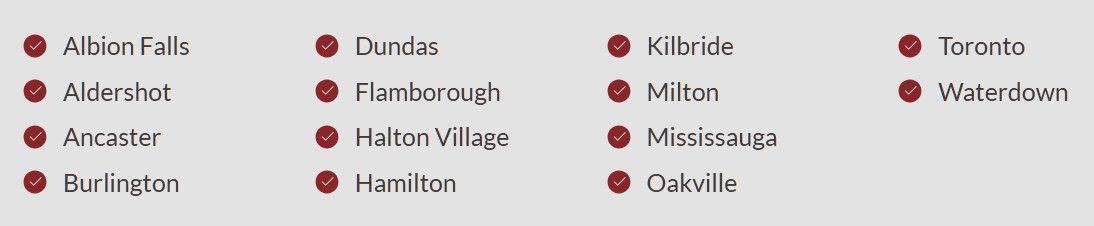
Location pages on the website of A1 Security Systems
A proper location page is written specifically for the customers in that city, not a generic audience. It uses geo-modified keywords in the heading and throughout the copy. It references local neighbourhoods and landmarks, the kind of detail that demonstrates real familiarity with the local area. It includes testimonials and job photos from that city. It displays the location's name, address, and phone number matching the corresponding GBP exactly. And it has an embedded Google Map linked to that specific location's GBP listing, reinforcing the service area that branch covers.
Generic templates with only the city name swapped are detectable by Google's algorithm and suppressed. A page built for Burlington has to be genuinely about Burlington.
Element 4 — Consistent Contact Information
Your website needs to display business information such as name, address and phone number (NAP) consistently but across the entire site. Placing location-specific NAP in the site footer means every indexed page on your website carries a consistent geographic signal to search engines. When it matches the corresponding GBP listing and local business listings in directories exactly, it reinforces the trust signal.
Your website needs to display business information such as name, address and phone number (NAP) consistently but across the entire site. Placing location-specific NAP in the site footer means every indexed page on your website carries a consistent geographic signal to search engines. When it matches the corresponding GBP listing and local business listings in directories exactly, it reinforces the trust signal.
For multi-location companies, a single generic contact page is not sufficient. Each location page needs its own NAP and its own embedded map tied to the correct GBP for that branch.
Element 5 — Technical Foundation: Speed, Mobile, and Structured Data
Content and keywords build the local search signal. The technical foundation determines whether search engines can read and act on those signals. Three technical elements carry the most weight for local search marketing.
Page Speed and Mobile Performance
Over 60% of local searches happen on mobile devices. Google uses mobile-first indexing, which means the mobile version of your site is the primary input for ranking decisions. Your local rankings suffer if your pages load slowly on a phone or display poorly on a small screen. Phone numbers need to be tap-to-dial and contact information needs to be visible easily and without much scrolling. A customer searching for urgent help is not going to hunt for your contact information.
Structured Data
Think of structured data as a label on the outside of a box. The content inside is your web page. The label tells Google exactly what is in it without having to read the whole page and guess: your business name, address, phone, hours, service area, and trade category.
For field service companies, this means telling Google not just that you are a local business, but specifically that you are an HVAC contractor in Burlington, or a licensed plumber serving Hamilton and Oakville. Each location page gets its own label with that location's specific details.
Structured data does not replace good content. It amplifies it by making your pages easier for search engines to understand and trust.
Your Website as a Local Ranking System
A website that performs well in local search marketing is not the result of one good page or one smart keyword. It is the result of five elements working together: local keywords, optimized title tags and meta descriptions, dedicated location pages, consistent NAP and map embeds, and a solid technical foundation, applied consistently across every market you serve.
When these elements are in place, your website stops being a passive presence and starts working as an active local SEO asset. It reinforces your Google Business Profile and gives search engines clear geographic signals for every city where you operate. That is what a complete local seo strategy looks like on the site you own.
At Mawazo Marketing we deliver digital marketing services and local search marketing for field service companies as part of our Marketing Operating System. Our SEO services and digital marketing approach treat your website as an integrated local ranking system. If you want to know where your website stands across your key markets, we can walk you through a local SEO audit and show you exactly where the gaps are.
Frequently Asked Questions
Do you have any questions on the above, or would you like to share your experience? Just email [email protected] or call (833) 503-0807.
At Mawazo Marketing we work with owners of B2B companies who want to accelerate their business. We help them with a concrete digital growth plan, a website that saves operational cost, and a digital marketing system that generates leads. For qualifying clients we offer a 5x ROI guarantee: if we don't reach the objective, then we pay back the difference. Book a Free Strategy Session to find out more.